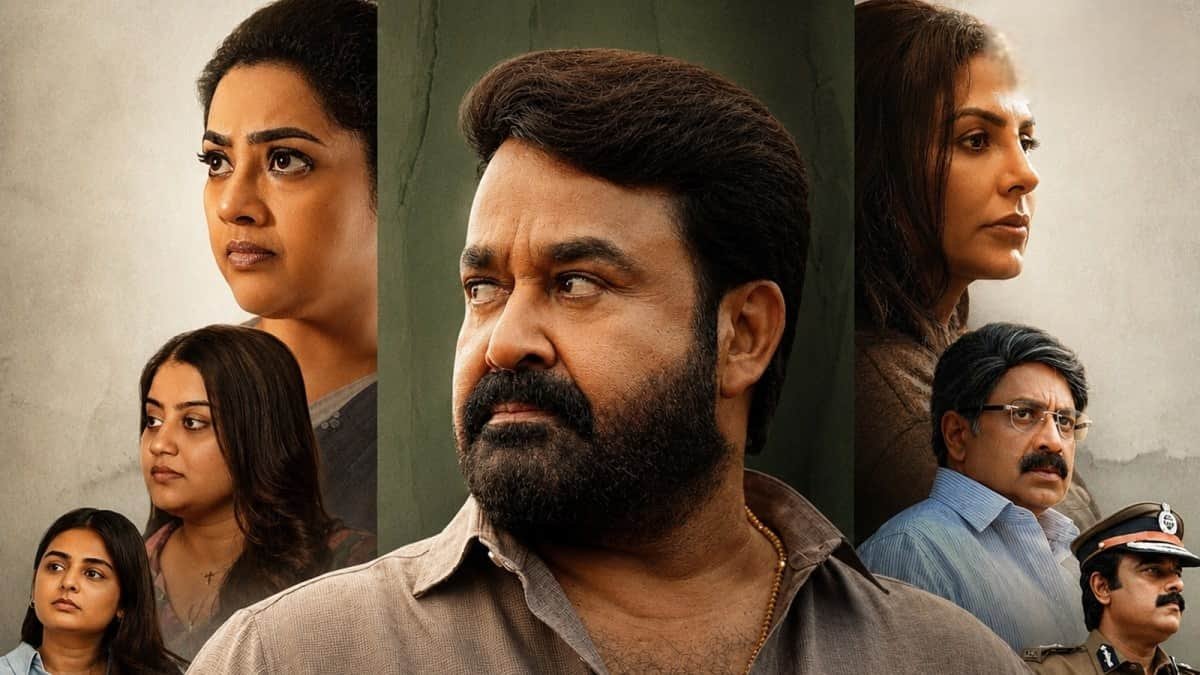
Drishyam 3 Review: Mohanlal’s Haunting Masterpiece Redefines the Franchise. Dive into our in-depth Drishyam 3 review, exploring how this sequel trades pure thrills for a profound, emotional crime saga led by a stellar Mohanlal.
Drishyam 3 Review: A Gripping Psychological Swan Song
The silence in a packed theater is a rare, almost sacred thing. It isn’t emptiness; it’s the sound of a thousand people holding their breath, completely tethered to the flickering images on a screen. I sat in that silence, utterly captivated, for the entirety of “Drishyam 3’s” 2-hour-and-39-minute runtime. This wasn’t the edge-of-the-seat, twist-a-minute suspense of its predecessors. This was something far more mature and, in its own quiet way, far more chilling: a profound meditation on guilt, fear, and the unbearable weight of a lie that has festered for over a decade. This Drishyam 3 review explores a film that bravely trades high-octane thrills for a deeply resonant family drama, and in doing so, delivers the most thematically rich chapter of the franchise yet.
The End of the Road (or the Beginning of a New One?)
After years of speculation and fervent anticipation, director Jeethu Joseph’s “Drishyam 3” finally landed in theaters on May 21, 2026—a release date that intentionally coincided with the legendary Mohanlal’s birthday. The premiere felt less like a movie opening and more like a global celebration. The film, which received a U/A 13+ certificate from the Central Board of Film Certification, saw a record-breaking opening, uniting the Malayalam-speaking diaspora and beyond in a shared moment of cinematic history.
The lead-up to its release was anything but smooth. The film was shot over a tight schedule from September to December 2025 and was initially slated for an April 2026 release. However, true to the franchise’s tradition of dramatic turns, an unforeseen global crisis forced a postponement. The new date, Mohanlal’s birthday, felt poetically just. It was a gift to millions of fans who have championed Georgekutty’s story since 2013, turning a simple cable operator into an enduring cultural icon.
Before the Curtain Rose: A Universe Revisited
To fully grasp the depth of “Drishyam 3,” a brief look back is essential. The 2013 original, “Drishyam,” wasn’t just a film; it was a cinematic earthquake. It introduced us to Georgekutty, an unassuming orphan who built his world around his wife Rani (Meena) and two daughters. When an accidental crime threatens to shatter his world, his encyclopedic knowledge of films helps him construct an elaborate alibi. The 2021 sequel, “Drishyam 2,” masterfully deepened the saga, revealing that the past wasn’t just buried; it was waiting, preserved in a police station’s foundation, ready to claw its way back to the surface at any moment. The story continued to resonate across the country, becoming a pan-Indian sensation that spawned successful remakes, including a blockbuster Hindi version starring Ajay Devgn as Vijay Salgaonkar.
A Plot That Wades into the Soul
“Drishyam 3” picks up the pieces four-and-a-half years later. On the surface, the waters have calmed. Georgekutty has achieved a new dream, morphing from a theater owner into a film producer, even making a movie based on his own life’s stormy events. The family is now preparing for a new chapter: the marriage of his elder daughter, Anju (Ansiba Hassan). This isn’t just a family event; it’s a beacon of hope, a desperate attempt to stake a claim on a “normal” future.
However, normalcy is a luxury the family can’t afford. Their infamous past is an invisible toxin, quietly poisoning every good thing. Promising marriage proposals collapse the moment the groom’s family digs into the family’s history. The threat this time isn’t a singular, cunning police officer like Geetha Prabhakar (Asha Sharath), who herself has given up the chase due to a lack of evidence. Instead, a new, more diffuse danger emerges, spearheaded by a relentless journalist who wants to make a documentary about the still-unsolved case.
But the most formidable enemy Georgekutty faces now is not external. It’s the gnawing paranoia that has taken root deep within him. In a haunting confession that echoes the film’s central theme, he admits, “Now, I am scared, sir, I don’t know who else is out there watching!” The hunter has become the hunted, and the film’s true genius lies in how it visualizes this internal dread.
The Ethical Chasm: Analyzing Georgekutty’s Moral Descent
The undeniable strength of the “Drishyam” series has always been its willingness to make audiences question their own moral compass. “Drishyam 3” plunges this ethical dilemma into even murkier waters, presenting Georgekutty not as a hero or a villain, but as a complex human being navigating an impossible reality. The film masterfully explores a pivotal question: Where does the instinct to protect one’s family end, and self-serving preservation begin?
- Ethical Dilemma
- Drishyam (2013):
- Protecting his daughter after an accidental, heat-of-the-moment killing.
- Drishyam 3 (2026):
- Maintaining the lie years after the immediate threat has passed.
- The Adversary
- Drishyam (2013):
- A righteous, powerful police force and a grieving mother seeking justice.
- Drishyam 3 (2026):
- Abstract forces of public opinion, media, and his own family’s trauma.
- Moral High Ground
- Drishyam (2013):
- The audience fully empathizes; the victim was a predator, and the act was a reflexive need to protect.
- Drishyam 3 (2026):
- The moral certainty has eroded; the lie is no longer about safety but about preserving a socially acceptable future at any cost.
- The Cost of the Lie
- Drishyam (2013):
- The family bonds together under an external threat.
- Drishyam 3 (2026):
- The family begins to fracture from within; the emotional isolation of each member is a slow-acting poison.
The film raises profoundly uncomfortable questions that linger long after the credits roll. When the physical threat subsides, does the lie become a prison of Georgekutty’s own making? Is he protecting his daughter, or is he now protecting his own meticulously crafted alibi, his status, and the cinematic legacy he has built from his crime? “Drishyam 3” bravely suggests that the greatest punishment for a mastermind is not the law catching up, but the slow, suffocating realization that his perfect plan was actually a perfect trap. This nuanced exploration transforms the film from a simple thriller into a compelling character study, cementing this as a key insight in any thoughtful Drishyam 3 review.
The Master at Work: Mohanlal’s Unforgettable Performance
A story this intricate could easily collapse under its own thematic weight. It doesn’t, and that is almost single-handedly due to Mohanlal. Numerous Drishyam 3 review narratives across social media platforms have called his performance the “saving grace” of the film, and it’s a point I must passionately echo. But his performance isn’t just a “grace”; it’s a full-scale masterclass in internalized acting that carries the entire film.
The Georgekutty of 2026 is a diminished man, not in wit, but in spirit. The confident, almost cocky strategist of the first film is gone. In his place is a man worn thin by exhaustion and fear. Mohanlal embodies this psychological decay not through grand, theatrical gestures, but through a devastating arsenal of micro-expressions. Watch his eyes in the film’s quieter moments. They are no longer the sharp, calculating eyes of a man two steps ahead; they are the weary, darting eyes of a prey animal, forever scanning for predators he can feel but cannot see .
His body language tells its own tragic story. His shoulders, once squared to shield his family from the world, now slump as if bearing a physical weight. The film’s emotional core is built on this performance. One early audience reaction brilliantly captured his magnetism, noting that he communicated Georgekutty’s mental state through “subtle body language, restrained dialogue delivery and his expressive eyes,” which held the audience captive for the entire 159-minute runtime. A viewer on X, perfectly encapsulating the fan frenzy, wrote, “What a movie, man… I don’t know how I spent 2Hr 39Min without blinking my eyes… @Mohanlal is an absolute performer to lend the series to success”. The supporting cast—a reliable Meena, a mature Ansiba, and a steadfast Esther Anil—does admirable work, but the film remains a towering monument to its leading man’s genius.
Jeethu Joseph’s New Canvas: Trading Twists for Tension
Perhaps the most divisive, and ultimately the most courageous, choice in the film comes from its writer-director, Jeethu Joseph. Many initial reactions, including a range of reviews, have highlighted a sense of disappointment that the film doesn’t match its predecessors’ cerebral, twist-driven mechanics. One critical review pointed out that “the writing couldn’t salvage Jeethu’s flat, uninspired visual execution,” leading to a “completely forgettable farewell”. This sentiment forms a core part of the mixed Drishyam 3 review landscape.
It’s a valid critique. The narrative, especially in its first half, is a slow, meditative burn that prioritizes emotional texture over a procedural cat-and-mouse game. Jeethu makes a deliberate and risky choice: he steers away from the expectations of the franchise to deliver gut-punching twists and instead focuses on the lingering, toxic aftermath of the crime. The film has been aptly described as “less clever, more dramatic,” and in this shift, it discovers its soul. This is a film about the long, arduous process of grief and the impossibility of true escape. The director himself, along with Mohanlal, had reportedly tried to temper expectations, telling audiences to expect a family drama rather than a puzzle box of massive twists.
However, this approach is not without its stumbles. The pacing in the first 100 minutes can feel sluggish, and some narrative threads, like the introduction of a seemingly important journalist, are introduced only to be forgotten. An old nemesis returns with an almost comical “red eye” that briefly threatens to derail the film’s somber tone. Yet, for those who surrender to its rhythm, the payoff is immense. The interval marks a decisive tonal shift, where the slow-burning family drama ignites into a gripping game of survival that charges towards a masterfully written climax.
The Climax and The Unshakeable Future
And what of that climax? Without venturing into spoiler territory, the final act is a testament to Jeethu Joseph’s narrative control. It doesn’t rely on a last-minute alibi or a hidden piece of evidence. Instead, it delivers an emotionally cathartic resolution that feels both inevitable and surprising. The ending, which masterfully combines a sense of closure for a 13-year saga with a final, tantalizing hook, has left the door unmistakably open. In a move that will either delight or frustrate fans, the film ends on a note that promises a “thrilling and sinister sequel,” turning Georgekutty’s story into a potential franchise for a new generation.
Mohanlal himself has fueled this speculation. At a trailer launch event, he playfully remarked, “I have asked for Georgekutty to be saved multiple times, but he is still not saved. So you can expect a Drishyam 4 also.” He then added, perhaps more seriously, “This is not a joke. Let people watch the film and let them decide whether we should do a sequel, like four or five”. The story of the man who knows a little too much about how to get away with murder may not be over yet.
Conclusion: The Verdict of a Hauntingly Human Saga
So, where does all of this leave us? “Drishyam 3” is not a perfect film. It is a film that bravely sheds its own skin. Audiences walking in expecting the nail-biting, high-concept suspense of the first two chapters will likely join the chorus of voices calling it the “least effective film of the franchise”. Its deliberate pace and deep dive into psychological trauma are a clear departure from the formula that made the series a global phenomenon.
Yet, for those willing to meet the film on its own terms, “Drishyam 3” is a stunning, emotionally resonant achievement. It transforms a beloved crime saga into a poignant family tragedy. It offers no easy answers, no triumphant victory laps for its anti-hero. Instead, it leaves you with the haunting image of a man who outsmarted the world but could never outrun himself. As this Drishyam 3 review has detailed, the film is a masterclass in acting and a bold narrative experiment that enriches the entire trilogy. It’s a film where the greatest twist is the quiet, devastating truth that some prisons don’t have bars.
Now, I want to hear from you.
Is “Drishyam 3” a worthy successor to its legendary predecessors, or did its shift to family drama leave you wanting more? Share your thoughts and your own rating of the film in the comments below. Let’s get the discussion going.