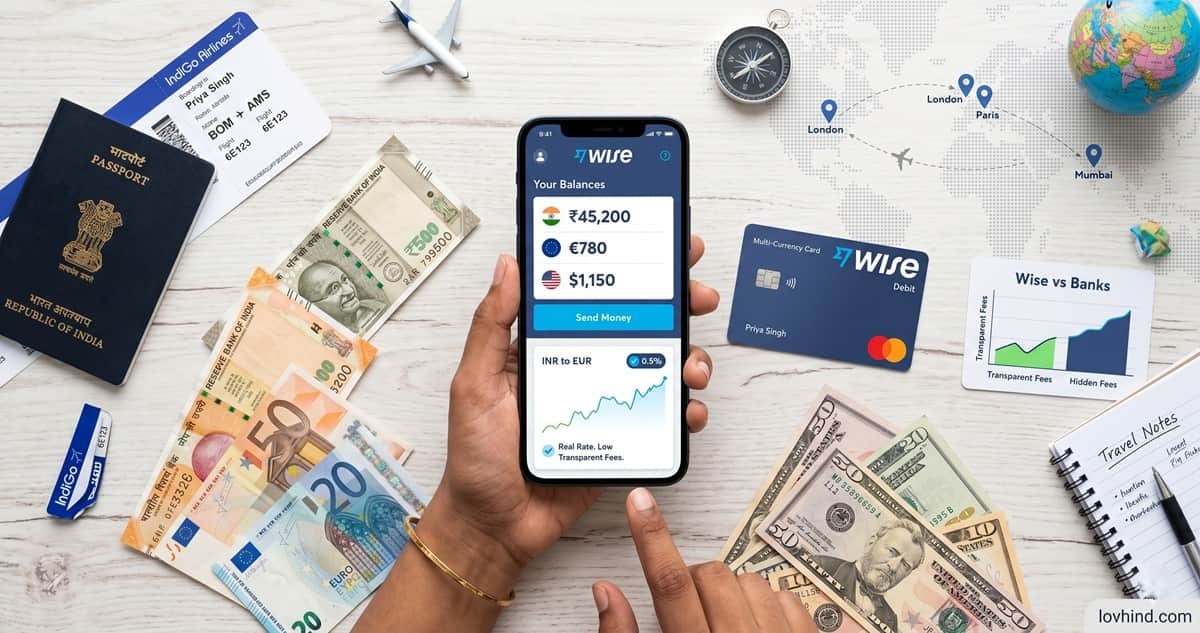
Wise India Guide 2026: How to Use Wise, Fees & Everything Indians Need to Know
Wise, formerly called TransferWise, remains popular in India among freelancers, remote employees, and global professionals. Many users rely on it to receive payments from overseas clients.
This guide explains Wise features for Indian users in 2026. It also covers FEMA compliance, supported foreign currencies, fees, platform limitations, and comparisons with competitors like Payoneer, Airwallex, and Skydo.
Picture this scenario. You approach a currency exchange counter at Indira Gandhi International Airport. The display flashes ₹92.50 for one US dollar. Meanwhile, Google shows the live rate at ₹95.20 on your phone. At first glance, the difference looks minor. However, the numbers quickly add up. On a ₹2 lakh family trip to Singapore, that exchange gap could cost you nearly ₹5,670 before your flight even takes off.
For years, Indian travellers accepted these hidden exchange losses as unavoidable. In 2026, however, a modern financial platform is changing that experience.
Wise has become a preferred solution for Indians handling international payments, travel spending, and foreign currency transfers. This detailed Wise India Guide 2026 explains how the platform works, its fees, supported features, and why millions of Indians now use it in a rapidly globalising economy.
Quick Summary: Wise India in 2026
Free Account Setup
Indian residents can open a personal Wise account without paying setup charges. Users can receive USD, EUR, GBP, and several other foreign currencies from international employers or clients.
No Wise Debit Card in India
Wise still does not offer its debit card to users with Indian residential addresses in 2026. This remains the platform’s biggest drawback for Indian customers.
Best for Receiving International Payments
Wise works especially well for freelancers using platforms like Upwork, Fiverr, and Toptal. Users can receive USD, EUR, and GBP through local account details.
FEMA Rules Still Apply
India’s Foreign Exchange Management Act regulates all international remittances. Therefore, foreign payments received through Wise must follow FEMA guidelines. Consult a qualified chartered accountant or tax advisor for situation-specific compliance advice.
LRS Limit for Overseas Transfers
The Reserve Bank of India allows resident Indians to remit up to USD 250,000 every financial year under the Liberalised Remittance Scheme. Consequently, Wise transfers abroad must stay within this limit.
The Three-Layer Hidden Cost Trap (And How Wise Dismantles It)
Most people judge a money transfer by its upfront fee. That is a catastrophic mistake. The true cost of sending rupees abroad—or bringing dollars home—has three distinct layers. Traditional banks bury their profits in the second layer, counting on you to never do the math.
Layer 1: The Flat Fee. This is the only number banks advertise clearly. A neat “₹750 + GST” for an outward remittance. It feels definitive. It is misleading.
Layer 2: The Exchange Rate Margin. This is the silent budget killer. When your bank converts INR to USD, they do not use the mid-market rate you see on Google. They apply a markup—typically 1.5% to 4% for Indian banks—and pocket the difference as pure profit. On a ₹5 lakh transfer, a 3% margin steals ₹15,000. The bank’s receipt will not show this number. It simply vanishes into the spread.
Layer 3: Correspondent Bank Charges. International wires routed through SWIFT often pass through one or more intermediary banks before reaching their destination. Each intermediary can deduct $10–$25 mid-route. The sender never sees this deduction. The recipient simply receives less than expected.
Wise disrupts all three layers simultaneously. It uses the mid-market exchange rate—the same one on Reuters and Google—with zero markup. Its fee is a separate, transparent percentage of the transfer amount, displayed on a calculator before you commit. And for most major corridors, Wise bypasses the SWIFT network entirely by using local payout rails, eliminating correspondent bank deductions.
Here is what this means in real numbers for a GBP 1,000 transfer to India, assuming a mid-market rate of approximately ₹107 per GBP:
- Exchange Rate Used
- Wise: Mid-market rate at approximately ₹107 per GBP
- Traditional UK bank SWIFT transfer: Usually 1.5–2% below the mid-market rate, around ₹105–₹105.40
- Sending Fee
- Wise: Around GBP 3.50, roughly 0.33% of the transfer amount
- UK bank SWIFT transfer: Flat fee between GBP 15 and GBP 40
- Correspondent Bank Charges
- Wise: No intermediary charges because of local payout infrastructure
- UK bank SWIFT transfer: Additional USD 10–25 often deducted during processing
- Indian Bank Receiving Charges
- Wise: No receiving fee in most cases
- UK bank SWIFT transfer: Around ₹200–₹1,000 plus 18% GST
- Approximate INR Received
- Wise: Around ₹103,400
- UK bank SWIFT transfer: Approximately ₹99,000–₹101,500
The gap on a single GBP 1,000 transfer is roughly ₹2,000 to ₹4,000 in Wise’s favour. Over twelve monthly transfers, that becomes ₹24,000 to ₹48,000 saved—simply by using a different pipe. Always use Wise’s real-time fee calculator before sending. The rupee amount your recipient sees is the rupee amount they receive. That number, not the headline rate, is your only honest benchmark.
Wise’s Fee Structure in 2026: A Granular Breakdown
Wise does not charge a subscription fee or a monthly maintenance fee. You pay only when you move or convert money. The cost varies by currency corridor because different currencies carry different underlying processing costs.
For GBP to INR transfers: Wise’s total fee is typically 0.33% to 0.65%—one of the cheapest corridors the platform operates. Pound sterling transfers to India use a highly optimised local settlement path, which keeps costs extraordinarily low.
For USD to INR transfers: The fee is higher, often 1.4% to 1.78%. This reflects a structural reality: USD transfers to India still route partially through SWIFT, which adds incremental processing expenses. Even at this higher tier, Wise remains significantly cheaper than traditional bank wires for amounts under roughly USD 30,000. For a USD 10,000 transfer, a bank’s combined fees and margin can easily exceed USD 300–400. Wise’s total cost for the same transfer sits around USD 140–180, including the digital Foreign Inward Remittance Advice (FIRA).
For EUR, AUD, SGD, and AED corridors: Fees generally range from 0.4% to 1.2%, depending on the specific currency pair and payment method. Transfers funded via bank debit (ACH, Faster Payments, SEPA) are cheaper than those funded by credit or debit card.
The Large Transfer Discount: Wise automatically applies a volume discount for transfers above USD 25,000 (or equivalent). The discount begins at that threshold and grows with the transfer size. For NRIs repatriating large sums—property sale proceeds, inheritance, or investment tranches—this discount narrows the gap with negotiated bank rates, though banks may still be competitive at very high values where relationship pricing kicks in.
The INR Holding Limitation: One crucial detail for Indian users: as of 2026, Indian residents cannot hold INR balances in their Wise multi-currency account. You can receive foreign currency, hold it, convert it, and spend it globally. But when money lands in India, it converts to INR and settles directly into your Indian bank account. This is a regulatory constraint, not a platform choice.
The 2026 Product Landscape: What Indian Users Get Now
Wise’s India offering has expanded meaningfully in early 2026, driven by regulatory approvals and surging demand from Indian travellers and freelancers.
The Multi-Currency Travel Card
In January 2026, Wise launched its multi-currency prepaid travel card for Indian residents. The timing was impeccable. India recorded 38.9 million outbound departures in 2024, and overseas spending has climbed sharply. Yet traditional forex cards from banks and travel agencies still slap hidden markups of 2% to 4% on currency conversions. On a ₹2 lakh transaction, that translates to ₹4,000–₹8,000 lost to the spread.
The Wise Travel Card uses the mid-market exchange rate and displays a transparent conversion fee upfront—typically averaging 0.5% across major currencies. It supports over 40 currencies, including popular destinations like Vietnam, Indonesia, Turkey, and Georgia, and works at Visa merchants in more than 160 countries.
Onboarding is entirely digital through India’s DigiLocker and video-based KYC. Travellers receive an instant digital card ready for immediate online use. Topping up happens via IMPS. The Smart Conversion feature automatically selects the best available rate at the point of sale abroad, even if you do not hold that currency in your wallet. Cash withdrawals up to $200 per month are free; beyond that, a fee of 1.40 USD plus 3.25% applies.
Wise waived the ₹460 card issuance fee for customers who signed up before 10 February 2026. The card carries no annual fees, subscription charges, or inactivity penalties. Over 75,000 users joined the waitlist within a month of announcement, signalling intense appetite for transparent travel pricing.
Multi-Currency Account with Local Bank Details
The Wise multi-currency account functions like a global current account. You can hold and manage over 40 currencies, receive payments like a local in major currencies (GBP, EUR, USD, AUD, NZD, SGD, CAD, and more), and convert between currencies at the mid-market rate with fees starting as low as 0.43%.
For Indian freelancers and exporters, this feature solves a critical pain point: getting paid by international clients without losing 3–5% to PayPal or bank wire fees. A US client can pay into your Wise USD account details via ACH, just like paying a local American vendor. You then convert to INR at the mid-market rate and withdraw to your Indian bank. The total cost is often under 1%.
Business users also gain access to batch payments—upload a spreadsheet and pay multiple international recipients in their local currencies at once—and API integration for automating payouts.
Regulatory Standing: RBI Authorisation
Wise operates in India through a carefully structured regulatory framework. Inbound remittance services are provided through a local banking partnership approved by the Reserve Bank of India. For outbound remittances and forex card services, Vaho Forex Private Limited holds a Category II Authorised Dealer licence from the RBI. In 2025, Wise secured in-principle approval for a Payment Aggregator licence, enabling cross-border receipts of up to ₹25 lakh per transfer for freelancers and businesses, with a pathway to eventually support outbound payments for Indian enterprises.
This multi-layered authorisation matters because it means Wise’s India operations are subject to RBI oversight, FEMA compliance, and purpose code reporting—the same regulatory obligations that govern traditional banks.
How to Set Up and Use Wise from India: A Step-by-Step Walkthrough
Step 1: Sign Up and Verify
Download the Wise app or visit wise.com. Register with your email and phone number. Indian users verify identity through DigiLocker integration and a video KYC process. The entire onboarding takes under 15 minutes for most applicants. Wise may request additional proof of address or source of funds for larger limits.
Step 2: Open a Multi-Currency Balance (Optional)
If you want to hold foreign currencies, activate the multi-currency account feature. This is free and unlocks local bank details in major currencies. Note: you cannot hold INR in this account.
Step 3: Add Money
Fund your Wise account via IMPS, NEFT, RTGS, or UPI from your Indian bank. For the travel card, you can also top up directly. Wise shows the exact amount you will pay in INR before you confirm.
Step 4: Send Money Abroad
Select the destination currency, enter the amount, choose the recipient, and review the all-in cost. Wise displays the exchange rate, the fee, and the exact amount the recipient will receive—all locked in before you hit send. Transfers to major currencies often arrive within 1–2 business days. If the recipient also has a Wise account, some transfers settle within seconds.
Step 5: Receive International Payments
Share your Wise local bank details (e.g., US ACH routing number, UK sort code, EU IBAN) with your client or employer. They pay you via local transfer in their country. You receive the funds in your Wise balance, convert to INR at the mid-market rate, and withdraw to your Indian bank account.
Step 6: Use the Travel Card Abroad
Activate your digital Wise Travel Card through the app. Load INR via IMPS and convert to the currencies you need before travel, or let Smart Conversion handle it at the point of sale. The card works wherever Visa is accepted, with free ATM withdrawals up to $200 per month. Use the app to freeze or unfreeze the card, set spending limits, and get real-time alerts.
Wise vs. the Competition: Who Wins for Indian Users in 2026?
The cross-border payments landscape for India is rapidly evolving. Wise faces credible competition from India-focused platforms, emerging fintech entrants, and traditional banks fighting to retain market share. Here is how they compare across the metrics that matter most to Indian users.
Wise vs. Infinity: The Freelancer’s Dilemma
Infinity is a modern cross-border payments platform purpose-built for Indian professionals and exporters. Its pitch is simple: a flat 0.5% all-inclusive fee, zero FX markup, and free Foreign Inward Remittance Advice (FIRA) on every transaction.
Wise charges approximately 1.6–1.8% for USD/EUR/GBP corridors plus $2.5 per digital FIRA. For a freelancer receiving twenty international payments per month, that FIRA cost alone hits $50 before factoring in the higher transaction fee.
Here is the comparison for a $10,000 receipt from a US client:
- Transaction Fee
- Wise: Approximately 1.8%, which equals around $180
- Infinity: Around 0.5%, which equals about $50
- FX Markup
- Wise: No foreign exchange markup because it uses the mid-market exchange rate
- Infinity: No FX markup
- FIRA Certificate Cost
- Wise: Around $2.50 per certificate
- Infinity: Free
- Total Effective Cost
- Wise: Approximately $182.50
- Infinity: Around $50.00
- Settlement Speed
- Wise: Usually takes 3–4 business days, depending on processing conditions
- Infinity: Typically settles within 24 hours
- Best For
- Wise: Multi-currency support and strong global recognition
- Infinity: Lower costs and India-focused compliance support
The verdict depends on your use case. If your primary need is receiving USD/EUR payments into India with minimal cost and fast INR settlement, Infinity is the more affordable, compliance-optimised choice. If you transact in multiple currencies across different countries, need local bank details for global receipts, or value the ability to hold and spend foreign currency balances, Wise’s global infrastructure remains unmatched.
Wise vs. Traditional Banks (ICICI, HDFC, SBI)
Traditional Indian banks still dominate the outward remittance market through branch-based relationships and trust. ICICI Bank, for instance, charges approximately ₹750 + GST per outward transfer, plus a forex markup that varies by customer segment. The overall cost on a USD 10,000 transfer can exceed ₹20,000.
Wise’s total cost for the same transfer sits around ₹12,000–₹15,000, with mid-market rates and no hidden margin. The platform earns an overall rating of 9.6 out of 10 on independent comparison sites, compared to ICICI Bank’s 6.0, with users citing transparent fees, fair exchange rates, and a smooth digital experience as key advantages.
Banks still win in a few scenarios: very large transfers above ₹25 lakh (Wise’s current per-transfer inbound limit), transactions requiring formal bank-letter documentation for property or investment compliance, and when the sender already holds a premium NRI relationship with the Indian bank’s overseas branch.
Wise vs. Revolut: The Indian Launch Gap
Revolut entered India in late 2025 with a consumer-focused waitlist, UPI integration, and a Visa card partnership. But as of mid-2026, Revolut has not confirmed business account support, FIRA/FIRC availability, or cross-border receiving features for Indian enterprises. Its India launch remains purely consumer-centric.
Wise, by contrast, already supports multi-currency business accounts with batch payments, API integration, digital FIRC, and full RBI-compliant inward remittance. For Indian freelancers and exporters who need compliance documentation and GST-ready records, Wise is currently the only game in town between the two global platforms.
Real User Voices: The Good, the Bad, and the Honest Truth
No financial platform pleases everyone. Wise’s user reviews across multiple independent sites reveal a pattern: overwhelmingly positive on pricing, speed, and ease of use, with recurring friction points around customer support and account verification.
What users consistently praise:
- Transparent, low fees. Users on TrustRadius repeatedly describe Wise as a cost-effective solution compared to banks, with accurate conversion rates and no hidden charges.
- Ease of use. The platform’s intuitive interface, fast mobile app, and straightforward transfer process earn consistent positive mentions.
- Speed. Most transfers complete within 1–2 business days. Wise-to-Wise transfers can settle in under 15 minutes.
What users criticise:
- Customer support responsiveness. Reviews on Good Money Guide from April 2026 highlight frustration: one user described an “urgent transfer issue while travelling internationally” that Wise “delayed and provided no effective assistance.” Another recounted spending four hours trying to reach a human agent after a transfer was flagged for review.
- Verification friction. Some users report repeated identity verification requests, sometimes twice in the same week. For Indian users, this can mean uploading documents multiple times and waiting for re-approval.
- Inconsistent processing times. While most transfers are fast, occasional delays of 3–4 business days occur, particularly for larger amounts or first-time transactions that trigger additional compliance checks.
The takeaway: Wise is a remarkably efficient, low-cost platform for routine transfers. But if you are sending a time-critical payment or anticipate needing immediate human support, have a backup plan. Keep a small balance in a traditional bank account for emergencies, and always initiate important transfers at least a day earlier than you think you need to.
Tax, Compliance, and FEMA: What Indian Users Must Know
Using Wise does not exempt you from Indian foreign exchange regulations. The Foreign Exchange Management Act (FEMA) governs all cross-border money flows, and the Liberalised Remittance Scheme (LRS) caps outward remittances at $250,000 per person per financial year.
For inward remittances: Money received from abroad must be classified under the correct RBI purpose code—such as P0802 for software consultancy exports or P1301 for family maintenance. Wise prompts you to select the appropriate code during the transfer process, and the digital FIRA (Foreign Inward Remittance Advice) or eFIRC (Electronic Foreign Inward Remittance Certificate) serves as proof for GST filings, income tax returns, and bank compliance.
For outward remittances: Every rupee sent abroad under LRS must have a valid purpose: travel, education, medical treatment, gifts, or investments. The receiving Indian bank—or Wise, through its authorised dealer partner—reports the transaction to the RBI. Keep digital records of every transfer. Your chartered accountant will need them.
Tax collected at source (TCS): As of 2026, outward remittances above ₹7 lakh in a financial year attract TCS at 5% (or 20% without PAN). This is collected by the authorised dealer at the time of transfer and can be claimed as a credit against your annual income tax liability.
GST on fees: 18% GST applies to the fee component of Wise transfers for Indian users. The GST applies only to Wise’s service charge, not to the principal transfer amount. Wise displays this tax separately in the transaction breakdown.
A Personal Perspective: When Wise Became My Default
I started using Wise in 2020, back when it was still called TransferWise and the multi-currency account was a “Borderless Account.” I was paying freelance contributors in Indonesia, Vietnam, and the UK. My Indian bank charged me ₹1,000 per wire plus a 3% forex margin. I was losing nearly ₹5,000 on a ₹60,000 monthly payroll.
Wise cut that to around ₹600. I uploaded an Excel sheet with three names, three amounts, and three currencies. The batch payment processed in ten minutes. The funds arrived the next day. I have used Wise every month since, and I have never once gone back to a bank wire for cross-border payments.
That said, I keep a traditional bank account open. When I needed to send ₹30 lakh for a property transaction, Wise’s per-transfer limit made a single transaction impossible. I split it across two transfers, but the bank’s negotiated rate for the full amount was actually slightly better. Platforms have ceilings. Smart users know where they are.
The Final Word on Wise in India
Wise is not a magic wand. It will not eliminate exchange rate risk, bypass FEMA limits, or provide white-glove concierge service when your transfer gets flagged at 2 a.m. But what it does—transparent pricing, mid-market rates, and genuinely useful multi-currency infrastructure—it does better than almost any alternative available to Indian users in 2026.
If you travel abroad, receive freelance income in foreign currency, send money to family studying overseas, or run a small business with international suppliers, Wise deserves a place in your financial toolkit. The travel card launch alone has changed the calculus for millions of Indian travellers fed up with opaque forex markups. The multi-currency account turns a smartphone into a global bank branch.
This Wise India Guide 2026: How to Use Wise, Fees & Everything Indians Need to Know is your starting point. Open an account. Send a test transfer of ₹1,000. Compare the rupee amount that lands against what your bank would have delivered. The difference, compounded over a year of transactions, may shock you. Share your experience in the comments below—did Wise save you money, or did you encounter a problem that made you reconsider? If you found this guide useful, subscribe to our newsletter for more deep dives on cross-border finance tools that actually work for Indians.