Undetectable AI: The Ultimate 2026 Guide to Humanizing AI Text & Bypassing Detection. Discover what Undetectable AI really is in 2026, how it works, the top tools tested, and the ethical debate shaping the future of content creation. Get the facts now.
Introduction: The Red Pen That Wasn’t Human
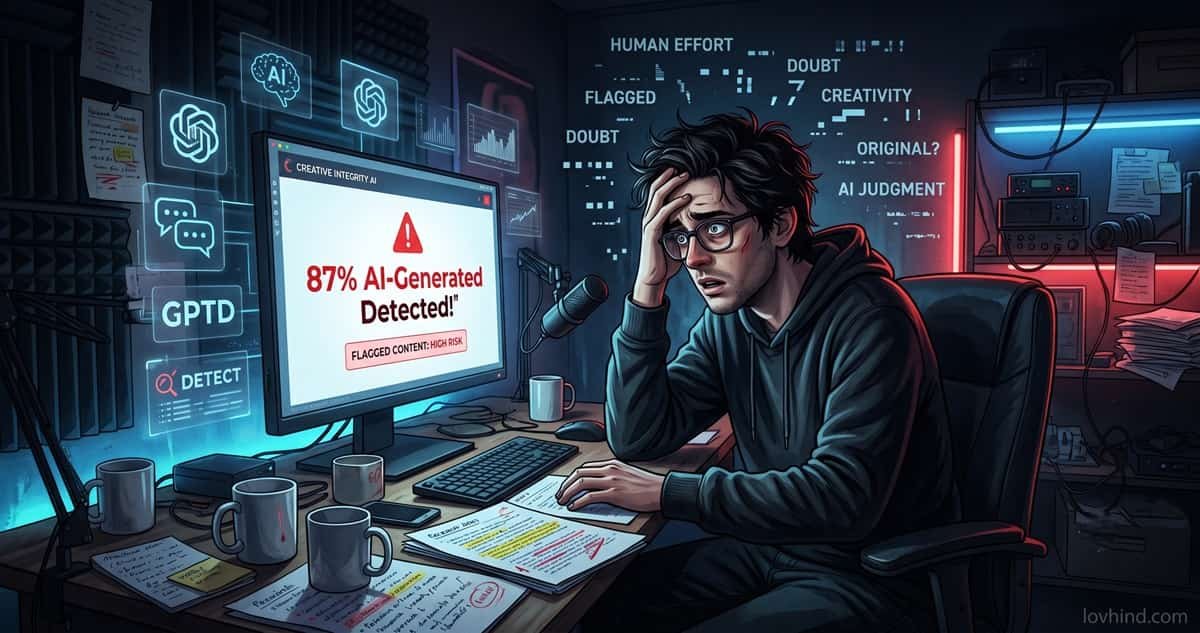
Imagine this. You just spent three days perfecting a blog post. You researched every stat. You polished every sentence. You ran it through an AI checker just to be safe. The screen flashes: “87% AI-Generated.” Your stomach drops.
That’s exactly what happened to one content creator who lost a $4,000 monthly client over a flagged article — an article they manually edited paragraph by paragraph. It feels unfair. It feels broken. And it is the reason why Undetectable AI has become one of the most searched terms in the creator economy.
We are living through a strange moment in writing history. On one side, AI tools like ChatGPT, Claude, and Gemini help us draft faster than ever. On the other side, institutions deploy sophisticated detectors like Turnitin and GPTZero to sniff out machine-generated text. Caught in the middle are honest writers, students, and marketers who simply want to work efficiently without being accused of cheating.
Undetectable AI promises a way out. It rewrites AI-generated content so it reads as a human wrote it — natural rhythms, natural imperfections, natural voice. But does it actually work? Is it ethical? And perhaps most importantly, why does a machine get to judge whether your writing is human enough?
In this post, I will take you inside the world of Undetectable AI — not with marketing fluff, but with real test results, research-backed insights, and a balanced look at the technology, the ethics, and the future of human-machine writing. Let’s get started.
The Detection Dilemma: How AI Content Checkers Actually Work
Before we can understand Undetectable AI, we must first understand what it’s trying to beat. AI detection is not magic. It is a probability.
Two Words: Perplexity and Burstiness
Most detectors rest on two core metrics.
Perplexity measures how predictable a piece of text is. Human writing tends to be surprising. We use unusual word combinations. We shift ideas mid-sentence. AI writing, by contrast, is statistically smooth. It chooses the most likely next word almost every time, which makes it highly predictable — and therefore low in perplexity.
Burstiness describes variation in sentence structure. Humans naturally mix short sentences with long, winding ones. We fragment. We emphasize. AI models, especially early versions, produce uniform, evenly-paced paragraphs that lack this rhythmic variety.
When a detector flags your content, it is essentially saying: This text is too perfect. Too predictable. Too smooth. The irony is almost painful.
The Detection Landscape
Popular tools like Turnitin, GPTZero, Originality.ai, and Copyleaks each use their own blend of these metrics plus machine-learning classifiers trained on vast corpora of human and AI text. Turnitin claims a false positive rate below 1%, but independent studies paint a different picture. In real-world deployment, that rate has been revised to around 4%. GPTZero showed false positive rates of 10% in some tests.
A 2023 study that assessed 14 detection tools found that none exceeded 80% accuracy. Only five managed to surpass 70%. That means even the best detectors get it wrong nearly one in three times.
- Turnitin
- Claimed Accuracy: 98%
- Real-World Observations: Strong on raw AI-generated text, weaker on paraphrased or humanized content
- False Positive Rate: ~1–4% (revised upward after deployment)
- GPTZero
- Claimed Accuracy: 99% (vendor claim)
- Real-World Observations: Independent tests observed around 10% false positives
- False Positive Rate: 10%+ (vs. claimed 1–2%)
- Originality.ai
- Claimed Accuracy: 99% (vendor claim)
- Real-World Observations: Around 91% accuracy in independent hands-on tests; considered an industry standard for content detection
- False Positive Rate: Varies depending on text type
- ZeroGPT
- Claimed Accuracy: Not specified
- Real-World Observations: Detected 96% of ChatGPT-generated text, but accuracy drops on edited content
- False Positive Rate: Higher for non-native English writing
The takeaway is clear: detectors are useful signals, not definitive proof. Yet universities and platforms often treat their scores as verdicts.
The Human Touch vs. The Machine Mind: Linguistic Fingerprints
What makes human writing fundamentally different from AI output? Researchers have been digging into this question with fascinating results.
A 2026 study in the Journal of Foreign Languages compared ChatGPT-generated essays with those by native English university students. ChatGPT significantly outperformed humans in lexical sophistication, lexical diversity, and lexical density. It used more low-frequency vocabulary and more complex noun phrases. In short, the AI sounded more academic than the academics.
But here’s where the machine fell short: it struggled with subordinate structures and complex logical relationships. Humans may use simpler words on average, but they connect ideas in more intricate, hierarchical ways.
Another study presented at a computational linguistics workshop found that human writers show higher variability in syntactic resources, while large language models score higher in lexical variability. In plain terms: AI knows a lot of fancy words but tends to use them in predictable sentence frames. Humans use more varied sentence structures even with a narrower vocabulary.
Research on informality features in academic writing revealed that ChatGPT exhibits a consistent, standardized style with less variability than human authors. Human academic writers — even in formal contexts — show more stylistic diversity, more personal touches, more of what we might call “voice.”
Key Insight: The most reliable fingerprint of AI writing is not word choice or grammar. It is uniformity. Human writing is messy, varied, and inconsistent in ways that feel natural. AI writing is clean, consistent, and uniform in ways that feel… off.
Undetectable AI: The Humanization Revolution
What It Is
Undetectable AI refers to tools that rewrite AI-generated text to mimic human writing patterns. They introduce the very “imperfections” that detectors look for: natural variance in sentence length, idiomatic expressions, occasional colloquialisms, and the subtle randomness that characterizes human prose.
The category exploded after the launch of ChatGPT. As AI detection tools became standard in education and publishing, demand grew for counter-tools that could help legitimate AI users avoid false flags. Undetectable AI launched in May 2023 and now claims over 22 million users.
What It Is Not
Let me be clear about something important. Undetectable AI does not make text invisible to checking. It rewrites text to reduce the statistical patterns that detectors flag. The result is writing that reads more human and therefore scores more human. But no tool can guarantee 100% invisibility across all detectors. The technology exists within an ongoing arms race.
Who Uses It and Why
The user base is broader than you might think:
- Students who use AI for brainstorming and drafting, but face strict institutional detection policies
- Content creators and bloggers producing high-volume SEO content with AI assistance
- Marketing teams scaling copy across channels without triggering spam or AI filters
- Freelancers delivering client work efficiently while maintaining quality
- Researchers are polishing AI-assisted drafts for publication
- Non-native English speakers whose natural writing style is disproportionately flagged as AI-generated
Inside the Humanizer: Tools, Techniques, and Tech
How does Undetectable AI actually transform a robotic paragraph into something that feels human? Let’s open the hood.
The Core Engine
At its heart, a humanizer uses advanced natural language processing, machine learning, and large language models trained specifically on the differences between human and AI writing patterns.
The process typically works like this:
- Input analysis: The tool scans your text for patterns commonly associated with AI: uniform sentence length, predictable word transitions, low burstiness, and overly formal or generic phrasing.
- Structural rewriting: Rather than simply swapping synonyms (which modern detectors easily catch), the tool restructures sentences, varies paragraph rhythm, and introduces natural transitions.
- Style adaptation: Most tools offer multiple writing modes — academic, journalistic, marketing, creative — to match the desired tone and context.
- Multi-detector verification: Many platforms include built-in checkers that test the output against Turnitin, GPTZero, ZeroGPT, Originality.ai, and others simultaneously.
Techniques That Actually Work
Independent testing has identified several approaches that consistently reduce AI detection scores:
Semantic restructuring rewrites content at the conceptual level, preserving meaning while changing how ideas are expressed. This beats surface-level paraphrasing because it alters the statistical structure that detectors analyze.
Sentence rhythm variation intentionally mixes short sentences with long, complex ones. It introduces fragments and compound structures that mimic natural human cadence.
Vocabulary rebalancing reduces reliance on the high-frequency academic vocabulary that LLMs favor and introduces more conversational, context-appropriate word choices.
Contextual detail injection adds specific, grounded details rather than generic descriptions. Compare “Discover the Magic of New York City: A Destination Like No Other” to “From the smell of roasted nuts in Central Park to the clatter of subway performers at Union Square, New York doesn’t try to charm you — it just does.” The latter is harder to flag because it contains concrete, variable-specific information.
Back-translation passes text through another language and back, which naturally alters phrasing and punctuation while preserving meaning.
Human-in-the-loop editing combines AI drafts with manual human revision focused on phrasing, flow, and stylistic nuance. This approach consistently produces the most detector-resistant output.
The Great Arms Race: Bypassing, False Positives, and Real-World Testing
Does Undetectable AI Actually Work?
The answer depends on which tool you use, which detector you test against, and how much human oversight you add.
A 90-day independent test of 31 AI detectors and humanizers found that properly configured tools achieved bypass rates of 86% to 91% against major detectors like Originality.ai and Turnitin. Interestingly, some custom GPTs priced at $5 per month matched or outperformed standalone SaaS tools costing $149 per month.
But consistency varies. One review noted that Undetectable AI produced inconsistent bypass results across different detectors — strong against some, weaker against others. Another found that while the tool improved readability and reduced detection signals, it did not make text fully invisible for high-stakes academic or compliance contexts.
The False Positive Crisis
Here is where the conversation gets serious. AI detectors disproportionately flag writing by non-native English speakers. A landmark Stanford study tested seven widely-used AI detectors on 91 TOEFL essays — all written by human non-native speakers. The results were devastating: detectors flagged 61.22% of these genuine student essays as AI-generated.
For native speakers, false positive rates fall below 10%. For non-native speakers, they soar above 60%. This is not just a technical glitch. It is algorithmic bias with real consequences.
Conservative estimates suggest that even at a 1% error rate, over 223,000 U.S. college students are falsely accused of AI cheating annually. The documented psychological harm includes panic attacks, depression, and suicidal ideation among wrongly accused students.
Several leading universities — including Vanderbilt, Cornell, Pittsburgh, and Iowa — have disabled AI detectors entirely, citing unreliability and equity concerns.
Turnitin’s Own Data
Turnitin reports that since October 2025, about 15% of essay submissions contained more than 80% AI-generated writing. At the same time, the company’s own research shows that Turnitin’s detection accuracy drops significantly when AI text is humanized — precisely the scenario that Undetectable AI tools create.
This creates a troubling dynamic: students who use AI honestly and then humanize the output may be harder to catch than students who submit raw AI text. The detection system inadvertently penalizes transparency while rewarding obfuscation.
The Ethics of Undetectable AI: Transparency, Integrity, and the Future
Let’s address the elephant in the room. Is using Undetectable AI cheating?
The Case for Responsible Use
Not all humanization is deception. Consider these legitimate scenarios:
- A researcher uses AI to draft a literature review, then extensively edits and humanizes the text to reflect their own voice and analysis. The AI was a drafting tool, not the author.
- A content marketer generates AI outlines and first drafts to speed up production, then humanizes and fact-checks every piece before publication.
- A non-native English speaker uses AI to improve grammar and clarity, then humanizes the output to ensure their natural voice comes through rather than being flagged as AI-generated.
In these cases, Undetectable AI functions more like an advanced grammar checker or style editor. The human remains in control. The human remains the author.
The Integrity Question
The line gets crossed when:
- A student submits a fully AI-generated, humanized essay as their own original work
- A freelancer delivers AI-humanized content while charging for original human writing
- A publication passes off AI content as human journalism without disclosure
Many institutions now treat undisclosed AI writing as a violation of academic integrity policies, even when the content is not copied from an external source. The issue is not tool use — it is transparency.
Ethical Principle: The same tool can be a legitimate productivity aid or an instrument of deception. The difference lies in disclosure, intent, and the rules of the context in which you operate.
What Thoughtful Voices Are Saying
Turnitin CEO Chris Caren captured the moment well: “The reality is students and educators alike are craving clear guidance on when and how to use AI.” The technology has outpaced the policies, and everyone is scrambling to catch up.
A 2026 paper on the fragility of AI detectors warned that “the statistical boundary between AI and human writing will inevitably dissolve as models improve.” The authors argue that detectors rest on a fundamentally unstable foundation and that the commercial incentives of detection companies — who profit from flagging content — create systemic bias toward false positives.
The responsible path forward likely involves shifting from detection-based policing to process-based verification: authentic assessments, writing portfolios, oral defenses, and transparency tools that show the writing journey rather than just the final product.
The Ultimate Comparison: Top Undetectable AI Tools at a Glance
I’ve reviewed the landscape. Here is a practical comparison of the leading Undetectable AI tools in 2026, based on independent testing and hands-on research.
- Undetectable AI
- Starting Price: $9.99/month
- Best For: General humanization and quick rewriting
- Bypass Consistency: Moderate — varies by detector
- Standout Feature: 8 writing modes, multi-detector check, Chrome extension
- Limitations: No essay writing, limited free plan, output may sound unnatural in “More Human” mode
- Aithor
- Starting Price: $24.99/month
- Best For: Students and full academic workflows
- Bypass Consistency: High — includes built-in detection and humanization
- Standout Feature: All-in-one platform for essay writing, detection, humanization, and paraphrasing
- Limitations: Higher pricing, no Chrome extension
- StealthGPT
- Starting Price: $5/month (via ChatGPT)
- Best For: Content creators, bloggers, and agencies
- Bypass Consistency: 89.3% against Originality.ai
- Standout Feature: Semantic restructuring with SEO keyword preservation
- Limitations: Requires ChatGPT Plus subscription
- Tenorshare AI Bypass
- Starting Price: $5.99/month
- Best For: Students, educators, and SEO writers
- Bypass Consistency: Strong — includes built-in verification
- Standout Feature: Supports 50+ languages, 3 humanization modes, and grammar correction
- Limitations: Limited rephrasing may oversimplify technical content
- WriteHuman
- Starting Price: Not specified
- Best For: Content professionals
- Bypass Consistency: Integrates with Turnitin and ZeroGPT
- Standout Feature: Produces natural, human-like output
- Limitations: Limited public pricing information
- Humbot AI
- Starting Price: Not specified
- Best For: Academic and creative writing
- Bypass Consistency: Multi-detector bypass support
- Standout Feature: AI Humanizer, Stealth Writer, and Essay Generator
- Limitations: Primarily focused on academic use cases
- Lynote AI Humanizer
- Starting Price: Free tier available
- Best For: Technical writers and developers
- Bypass Consistency: Reported 90–100% human scores
- Standout Feature: Preserves technical accuracy and SEO keywords, no sign-up required
- Limitations: Limited rephrasing may oversimplify technical text
A Quick Buyer’s Guide
- For students and academics: Choose a tool that preserves academic tone without simplifying complex arguments. Aithor or the TurnitinPRO custom GPT are purpose-built for this.
- For content creators and marketers: StealthGPT or Lynote offer strong bypass rates with SEO keyword preservation — critical for ranking.
- For general, budget-conscious use: Undetectable AI’s $9.99/month plan covers most needs, but be prepared to do some manual editing for high-stakes content.
- For multilingual users: Tenorshare AI Bypass supports 50+ languages, making it the most versatile option.
The Bigger Picture: Beyond Detection to Writing Transparency
The Undetectable AI phenomenon reveals something deeper about our relationship with writing technology. We are uncomfortable with AI-generated text not because it is bad — often it is quite good — but because it challenges our understanding of authorship and authenticity.
The detection arms race is likely unsustainable. As language models improve, the boundary between human and AI writing will blur further. A 2026 paper argued that “language models are trained on human-written corpora, so the statistical boundary between AI and human writing will inevitably dissolve.”
Some institutions are already shifting toward a better approach. Turnitin’s Clarity product, launched in July 2025, tracks writing activity throughout an assignment and includes an AI assistant that provides feedback without writing for the student. Early data shows that 94% of students wrote their own prompts rather than using pre-written suggestions, and many used the assistant for genuine feedback — “Is this a strong conclusion?” rather than “Write my essay.”
This points toward a healthier future: one where AI is integrated transparently into the writing process, where tools support rather than replace human thinking, and where the focus shifts from catching cheaters to developing authentic writers.
Conclusion: Living in the Gray Zone
Undetectable AI is not a magic wand. It will not make your AI-generated text invisible to every detector. It will not absolve you of the responsibility to think, to edit, to write with integrity.
But it does reveal something important about our current moment. The tools that judge whether writing is “human enough” are flawed, biased, and increasingly questioned by the very institutions that adopted them. The statistical signals they rely on are dissolving as AI improves. And honest writers — especially those whose natural style doesn’t match the detector’s training data — are paying the price.
The smartest approach in 2026 is not to hide AI use but to use AI responsibly and transparently. Draft with AI. Think with AI. But also edit with care, verify with rigor, and own every word you publish. Use humanization tools if you must, but treat them as polish, not deception.
Because here is the truth that no detector can measure: the best writing — whether drafted by human, machine, or both — is writing that connects. Writing that matters. Writing that says something real.
And that is something only you can provide.
What’s Your Experience?
Have you been falsely flagged by an AI detector? Do you use humanization tools in your workflow? I’d love to hear your perspective — drop a comment below or join the conversation on social media.
If you found this guide helpful, consider sharing it with a colleague who’s navigating the same gray zone. And if you want to stay ahead of the rapidly evolving world of AI and content, subscribe to our newsletter for weekly insights delivered straight to your inbox.
Disclaimer: This article discusses tools that can bypass AI detection. Always follow your institution’s academic integrity policies and your platform’s content guidelines. Responsible use matters.