What is the Primary Market? How Companies Raise Capital & Why It Matters: Discover what the primary market is, how IPOs and other new securities are issued, and the latest trends shaping India’s capital-raising engine—your complete guide to the primary market.
What is the Primary Market? The Engine Room of Capital Formation
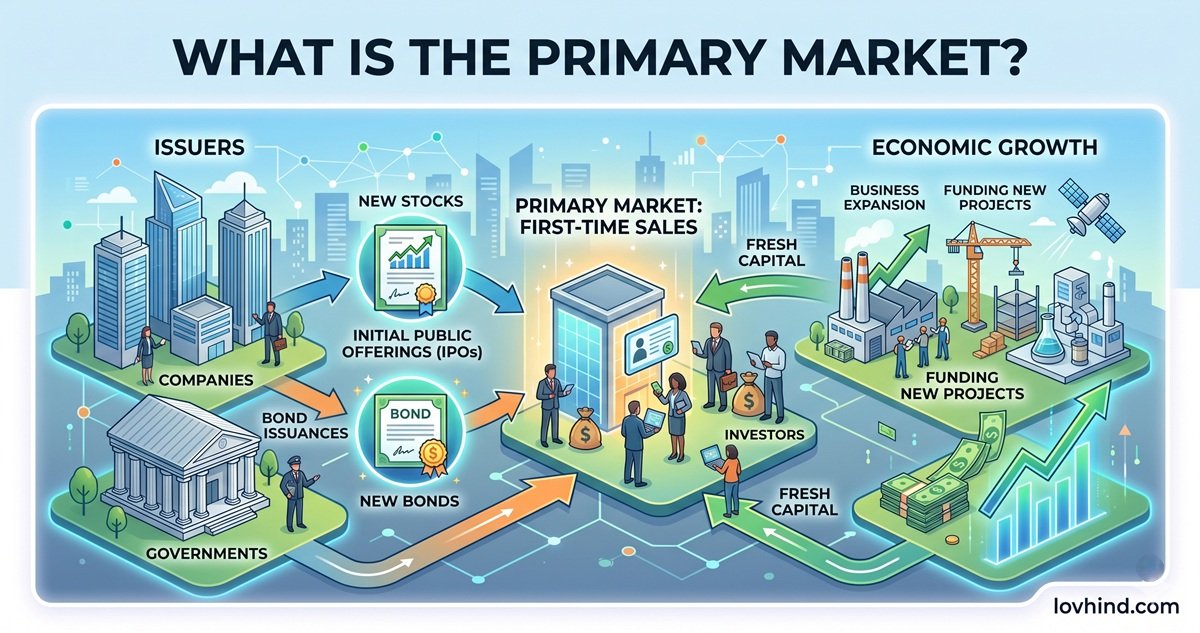
Imagine you hold a backstage pass to the biggest show in finance—the moment a private company steps into the public spotlight for the very first time. That moment happens in the primary market. So, what is the primary market? It is the birthplace of financial securities, where companies and governments sell fresh stocks or bonds directly to investors to raise capital. It’s the only place where your money flows straight into a company’s treasury, fueling its expansion, innovation, or debt repayment.
The primary market represents a platform where securities such as equity shares, bonds, and debentures are issued to the general public for the first time. The Securities and Exchange Board of India (SEBI) regulates these issuances, ensuring transparency, fair play, and investor protection at every step.
In this guide, we’ll unpack the inner workings of the primary market, explore the different issue types, trace the step-by-step IPO journey, dive into recent trends—especially India’s 2025–2026 activity—and provide fresh insights that go far beyond textbook definitions.
Defining the Primary Market: More Than Just IPOs
What Exactly is the Primary Market?
The primary market is the financial market where new securities are created and become available for purchase by individuals and institutions. In simpler terms, it’s the new issue market. Securities flow directly from the issuer—be it a corporation, a government, or a municipality—to the investor. The issuer receives the funds, and the investor receives brand-new ownership certificates or debt instruments.
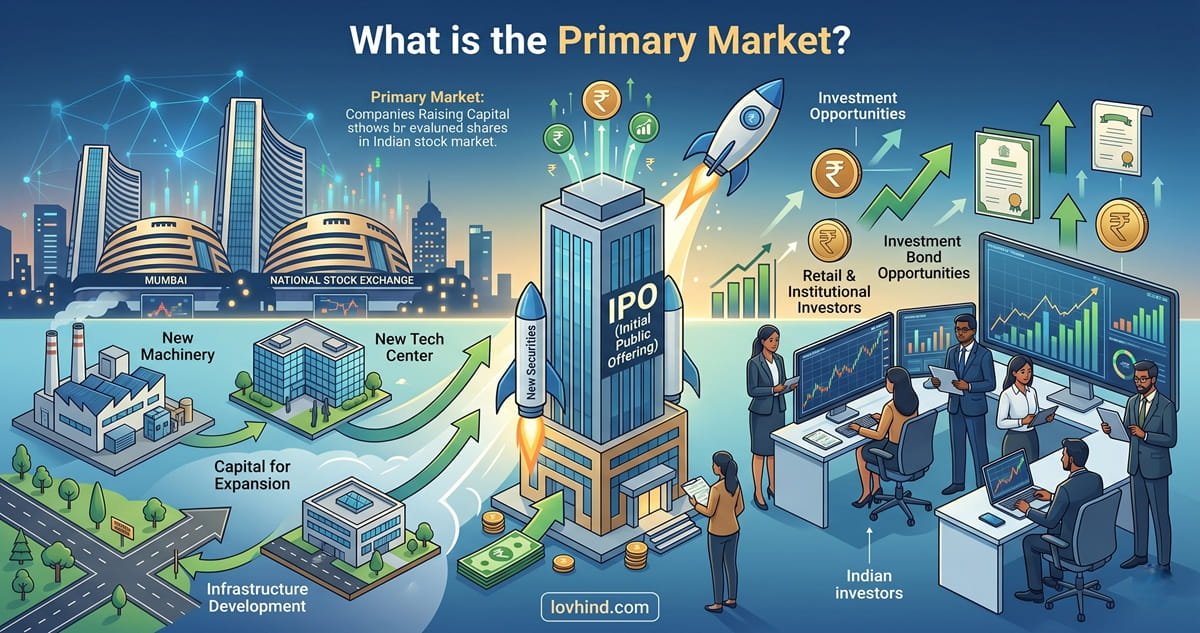
Crucially, this market is not a physical place but a mechanism for capital formation. When a company raises money for the first time from the public through the primary market, the process is known as an Initial Public Offering (IPO). But the primary market isn’t limited to IPOs. After a company is already listed, it can return to the primary market to issue additional shares via a Follow-on Public Offer (FPO) or raise funds through rights issues, private placements, and preferential allotments.
Key Features of the Primary Market
- Issuance of New Securities – Only newly created shares or bonds are sold in the primary market.
- Capital Mobilization – Funds raised go directly to the issuing company or government for business expansion and other purposes.
- Regulatory Oversight – The market operates under strict regulations from authorities like the Securities and Exchange Board of India (SEBI).
- Pricing Freedom – Issuers decide the price of securities, often with the assistance of underwriters or investment banks.
- One-Time Sale – Securities are sold only once in the primary market; afterward, they are traded in the secondary market.
The primary market is where the magic of capital formation happens—turning savings into productive investments that drive economic growth.
Primary Market vs. Secondary Market: A Side-by-Side Comparison
To truly understand what the primary market is, it helps to contrast it with the secondary market. While the primary market deals with the issuance of new securities, the secondary market provides liquidity and ongoing price discovery for those securities. In the secondary market, investors buy and sell already-issued securities among themselves, without the issuing company’s involvement.
- Primary Market Examples – IPOs (Initial Public Offerings), new bond issues, and rights issues.
- Secondary Market Examples – Buying and selling shares on the Bombay Stock Exchange (BSE) and the National Stock Exchange of India (NSE).
Primary Market vs Secondary Market
- Definition
- Primary Market: Market where new securities are issued for the first time.
- Secondary Market: Market where already-issued securities are traded.
- Participants
- Primary Market: Issuers, underwriters, and first-time investors.
- Secondary Market: Investors, brokers, and stock exchanges.
- Purpose
- Primary Market: Helps companies raise fresh capital.
- Secondary Market: Provides liquidity and easy trading opportunities for investors.
- Price Setting
- Primary Market: Prices are decided by issuers and underwriters, often through book-building.
- Secondary Market: Prices are determined by market demand and supply.
- Involvement of Issuer
- Primary Market: The issuer is directly involved and receives the funds.
- Secondary Market: The issuer is not directly involved; money moves between investors.
- Number of Sales
- Primary Market: Securities can be sold only once.
- Secondary Market: Securities can be traded multiple times without limit.
The primary market creates investments, while the secondary market gives them liquidity and ongoing opportunities for trading.
The Mechanics: How New Securities Are Issued
Understanding the different types of primary market issuances is key. Each type caters to specific funding needs and investor groups.
1. Initial Public Offering (IPO)
An IPO is the first-time sale of shares by a private company to the public. It marks the company’s transition from private to public and gets it listed on a recognised stock exchange. Investors apply through authorised channels, and allotment is made based on regulatory guidelines and subscription demand.
2. Follow-on Public Offer (FPO)
An FPO occurs when an already listed company issues additional shares to raise further capital. The process resembles an IPO but focuses on increasing existing equity rather than creating a new listing.
3. Rights Issue
In a rights issue, a company offers additional shares to its existing shareholders in proportion to their current holdings. Shareholders have the choice to subscribe at a pre-determined price or let the offer pass. This helps companies raise funds from those who already support them.
4. Private Placement
Private placement involves issuing securities to a select group of investors rather than offering them to the general public. These could include institutions or select individuals. It’s a targeted approach that does not involve open participation from the public.
5. Preferential Allotment
Preferential allotment refers to the issuance of shares to selected investors—such as venture capitalists or promoters—at pre-determined terms in compliance with regulatory requirements. It helps companies raise funds quickly through selected partners.
6. Qualified Institutional Placement (QIP)
A QIP is a mechanism through which listed companies raise capital from institutional investors without undergoing lengthy regulatory procedures. It’s a private placement of securities by a listed company to qualified institutional buyers.
The IPO Journey: A Step-by-Step Breakdown
Bringing an IPO to market is no small feat. In 2025 alone, India saw 373 IPOs—103 mainboard and 270 SME issues—raising around ₹1.95 trillion. Let’s trace the regulated pathway that transforms a private company into a publicly traded one.
Phase 1: Pre-IPO Preparation
Before the first investor applies, the issuer must undergo rigorous preparation. This phase involves meeting strict eligibility criteria, assembling a team of SEBI-registered intermediaries, and ensuring all corporate governance and compliance requirements are met.
Eligibility Test
SEBI’s ICDR Regulations prescribe two main routes:
- Profitability Route
- Net tangible assets of at least ₹3 crore in each of the previous three years.
- Average operating profit of at least ₹15 crore.
- Net worth of at least ₹1 crore per year.
- QIB Route (Qualified Institutional Buyers Route)
- At least 75% of the net offer must be allotted to Qualified Institutional Buyers (QIBs).
- Designed for companies that do not meet the standard profitability requirements.
Issuers must also ensure that their promoters, directors, or selling shareholders are not debarred from the capital market and that no one is classified as a willful defaulter or fraudulent borrower.
Assembling the Team
The company appoints a host of intermediaries, including:
- Merchant Bankers (lead managers)
- Underwriters
- Registrar & Transfer Agents
- Legal Counsel
- Statutory Auditors
Phase 2: The Live IPO Period
- Draft Red Herring Prospectus (DRHP): The company files a DRHP with SEBI, providing comprehensive details about its business, financials, risks, and how the IPO proceeds will be used.
- SEBI Review and Approval: SEBI may seek clarifications and suggest revisions. Once satisfied, it issues an “observation letter.” The issuer must file a Red Herring Prospectus (RHP) with SEBI and the Registrar of Companies. Under current norms, observation letters are valid for 12 months (or 18 months for confidential filings).
- Book-Building and Pricing: The issuer, along with lead managers, determines a price band. Investors bid within this range, and the final price is discovered based on demand. SEBI mandates a minimum difference of 5% between the floor and cap price.
- Subscription Period: The IPO must remain open for a minimum of 3 working days and a maximum of 10 working days. Investors apply through ASBA (Application Supported by Blocked Amount), where funds are blocked until allotment. For retail investors, a UPI mandate is mandatory for applications below ₹5 lakh.
Allotment Rules
SEBI has structured the allotment process to balance investor classes:
| Investor Category | Reservation |
|---|---|
| Qualified Institutional Buyers (QIBs) | 50% |
| Non-Institutional Investors (NIIs) | 15% |
| Retail Individual Investors (RIIs) | 35% |
If applications exceed the available quota in the retail category, a lottery system is applied.
Phase 3: Post-IPO Responsibilities
Post allotment, the company’s shares are listed on the stock exchanges. From this point onward, the shares trade on the secondary market. The company must comply with ongoing disclosure and corporate governance obligations under SEBI’s Listing Obligations and Disclosure Requirements (LODR) Regulations.
Functions of the Primary Market: Beyond Capital Raising
The primary market serves several critical functions in the financial ecosystem:
- Capital Formation: Directly transforms household savings into productive business investments.
- Price Discovery: Establishes a fair market price for new securities through book-building and demand assessment.
- Liquidity Facilitation: Creates a bridge to the secondary market, where securities can later be freely traded.
- Economic Growth: Enables businesses to expand, innovate, and create jobs.
- Investor Access: Offers investors the opportunity to participate in a company’s growth story from the very beginning.
Regulatory Framework: SEBI’s Guardianship
SEBI’s oversight is the backbone of India’s primary market integrity. Its regulations span company eligibility, documentation, pricing, application process, allotment rules, and post-listing compliance.
Recent Regulatory Developments
In 2025–2026, SEBI introduced several key measures:
- Faster Rights Issues: An efficient framework now allows the completion of a rights issue process within 23 working days, eliminating the need to file draft letters of offer for SEBI approval.
- Lock-In on Pledged Shares: In April 2026, SEBI enabled depositories to tag certain shares as “non-transferable” during the lock-in period, particularly when a conventional lock-in cannot be imposed. This prevents promoters from bypassing lock-in requirements and strengthens investor protection.
- IPO Timeline Relaxation: Amid ongoing market volatility and geopolitical tensions, SEBI extended the validity of observation letters set to expire up to September 30, 2026, offering relief to companies planning to tap the primary market.
- Merchant Banker Norms: SEBI set phased capital, revenue, and compliance timelines for merchant bankers to ensure only well-capitalised intermediaries manage public issues.
These measures reflect SEBI’s proactive stance in maintaining market stability and investor confidence.
The Indian Primary Market: Record Highs and Cautious Pauses
India’s primary market has witnessed a whirlwind of activity in recent years. The year 2025 marked a defining phase, with 373 IPOs—comprising 103 mainboard and 270 SME issues—raising around ₹1.95 trillion (approximately $23 billion). Mainboard IPOs alone crossed the 100-issue mark for the first time since 2007. The total IPO fundraising touched ₹1.8–1.9 lakh crore, surpassing the previous peak of about ₹1.6 lakh crore in 2024.
2026: A Subdued Start
However, momentum has cooled in early 2026. Only five mainboard IPOs opened for public subscription in the first few months, with subscription levels moderating sharply. Investor appetite has weakened, partly due to geopolitical uncertainties and fading listing-day euphoria.
Data from the PRIME Database reveals that, as of April 30, 2026, 67 out of 115 IPOs (approximately 58.2%) between January 2025 and March 2026 were trading at a negative gain relative to their offer price. While nearly 60% of IPOs delivered positive listing-day gains, the median return later turned negative at approximately -14%.
“It is unfair to expect all IPOs to not just give a positive return on the listing day but also to continue to trade above the issue price for the rest of their entire life cycle. After a company gets listed, it becomes like any of the other 2000+ listed companies,” said Pranav Haldea, Managing Director at PRIME Database Group.
Despite the cooling, the pipeline remains robust. Over 170 draft IPO documents have been filed with SEBI, and fundraising is expected to surpass 2025’s $20 billion haul in 2026. Around 144 companies looking to raise ₹1.75 trillion have already received SEBI clearance and are awaiting market entry.
Sector Trends
New-age companies—particularly in technology, fintech, and e-commerce—are expected to lead listings over the next 12–18 months. Nipun Goel, President at IIFL Capital Services, expects 30–40 listings from new-age sectors. Investors increasingly evaluate companies based on growth visibility, governance standards, and sustainable business models rather than chasing speculative hype.
Pros and Cons of Investing in the Primary Market
Every opportunity comes with its own risk-reward profile. Here’s a balanced view:
- Pros: Potential to buy shares at attractive valuations before listing
Cons: Limited historical data to assess post-listing performance - Pros: Direct participation in a company’s growth story
Cons: Listing-day volatility and potential for negative returns - Pros: SEBI-regulated process ensures transparency and disclosure
Cons: Lock-in periods for certain categories of investors - Pros: Opportunities for long-term wealth creation
Cons: Risk of oversubscription, leading to partial allotment - Pros: Tax benefits in certain cases, such as long-term capital gains
Cons: Misaligned incentives when companies overprice IPOs to maximise proceeds
As the data shows, investors who exit on or shortly after listing are more likely to capture gains. Those who stay invested must be prepared for the stock’s performance to ultimately depend on the company’s fundamentals and broader market conditions.
Common Myths About the Primary Market
- Myth: “Primary market only means IPOs.”
Reality: It also includes FPOs, rights issues, private placements, preferential allotments, and QIPs. - Myth: “All IPOs give listing-day profits.”
Reality: Around 40% of IPOs in 2025–2026 delivered negative listing-day returns. - Myth: “Investing in the primary market is risk-free.”
Reality: Securities are subject to market risks, and post-listing performance can be volatile. - Myth: “Only big institutions can participate.”
Reality: Retail investors can apply in IPOs with a minimum lot size, often around ₹14,000–₹15,000. - Myth: “Primary market transactions happen on stock exchanges.”
Reality: The primary market is not a physical exchange; securities are issued directly by the issuer.
The Global Perspective: Primary Markets Beyond India
While India’s primary market has been exceptionally active, the concept is universal. In the United States, the Securities and Exchange Commission (SEC) regulates primary market issuances. In 2024, the US IPO market saw a resurgence driven by technology and healthcare companies. Europe, too, witnessed a revival in IPO activity after a subdued 2022–2023 period.
Despite varying regulatory frameworks, the core functions remain the same: mobilising capital, enabling ownership diversification, and fostering economic growth. The primary market remains the most direct bridge between savers and the real economy—a role that no other financial market can replicate.
FAQs about Primary Markets
1. What is the primary market in simple terms?
The primary market is the marketplace where new stocks and bonds are created and sold by companies or governments directly to investors for the first time. It is where capital formation happens.
2. How is the primary market different from the secondary market?
In the primary market, securities are sold by the issuer to investors, and the company receives the funds. In the secondary market, investors trade securities among themselves, and the company receives no money.
3. Can retail investors participate in the primary market?
Yes, retail investors can apply in IPOs and other public offerings, typically with a minimum lot size. SEBI mandates 35% reservation for retail individual investors in IPOs.
4. What happens to the money I invest in an IPO?
Your money goes directly to the company for use in business expansion, debt repayment, or other corporate purposes. Once shares are listed, your ownership can be traded on the secondary market.
5. Is investing in the primary market safe?
No investment is entirely safe. While SEBI regulations enforce transparency, the post-listing performance of IPOs can be volatile. Investors should evaluate fundamentals carefully.
6. What are the recent trends in India’s primary market?
India’s primary market saw record fundraising of nearly ₹1.95 trillion in 2025. Early 2026 has been subdued, but a robust pipeline of over 170 draft IPO documents suggests a rebound is likely.
Final Thoughts: The Primary Market’s Enduring Relevance
So, what is the primary market? It is far more than a financial gateway—it is the crucible where private ambition meets public capital, the stage on which companies step out of obscurity, and the mechanism through which ordinary investors can own a piece of tomorrow’s industry leaders. From the biggest billion-dollar IPOs to a small SME raising funds for expansion, the primary market fuels economic growth one issuance at a time.
As India’s regulatory framework evolves and investor maturity deepens, the primary market will continue to play a pivotal role in channelling household savings into productive enterprise. Whether you’re an aspiring investor or a curious observer, understanding the primary market equips you to navigate the financial world with confidence—and perhaps spot the next big opportunity before it hits the headlines.
Loved this deep dive? Share your thoughts in the comments below, and don’t forget to subscribe to our newsletter for more in-depth financial insights delivered straight to your inbox.