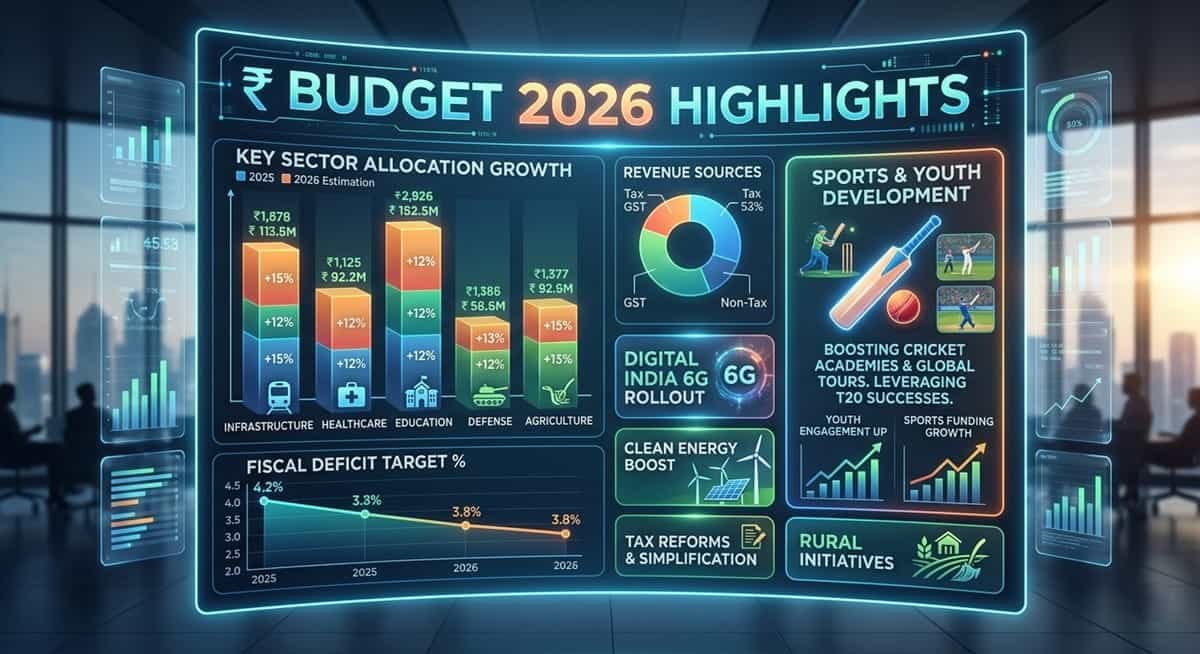
Budget 2026 Highlights: The Union Budget 2026 was presented on 1st February 2026 by Nirmala Sitharaman. Notably, this marks her ninth consecutive budget.
Key Focus Areas
The government emphasized economic stability and long-term sustainability. Additionally, it prioritized infrastructure development and manufacturing growth. It also supported MSMEs and strengthened the railways sector.
Reforms and Emerging Sectors
Moreover, the budget focused on ease of living and simpler compliance. Furthermore, it promoted emerging sectors like artificial intelligence and semiconductor manufacturing.
Budget 2026 Highlights Summary
Here are the key highlights of Budget 2026.
Infrastructure and Growth
The government increased public infrastructure allocation to ₹12.2 lakh crore for FY 2026–27. Additionally, it emphasized long-term economic growth.
Defence and Security
The government raised defence allocation to ₹7.85 lakh crore due to rising global tensions.
Investment Reforms
Now, a Person Resident Outside India can invest in Indian listed equities. They can invest through the Portfolio Investment Scheme with a 10% limit.
Tax Filing Updates
The government extended the revised return filing deadline to 31st March of the next tax year. However, it will charge a nominal fee. It also extended the ITR filing deadline to 31st August for non-audit business taxpayers.
Capital Gains and Deductions
Sovereign Gold Bonds qualify for capital gains exemption only if held until maturity. Moreover, the government removed interest deduction against dividend and mutual fund income.
Three Kartavyas (Core Duties)
The Union Budget 2026 focuses on three key kartavyas of the government. These duties define its responsibility towards citizens.
- First, it aims to accelerate and sustain economic growth.
- Second, it seeks to fulfil citizens’ aspirations.
- Third, it ensures inclusive development under “Sabka Saath, Sabka Vikas.”
Direct Tax Proposals
Key Changes Overview
The government kept income tax slabs unchanged for all taxpayers. However, it extended several filing deadlines and revised key rules.
ITR Filing Updates
The government extended ITR filing to 31 August for non-audit taxpayers. This applies to ITR-3 and ITR-4 from FY 2025–26. Therefore, the new due date for AY 2026–27 is 31 August 2026.
Revised Return Deadline
The government extended the revised return deadline to 31 March. Earlier, the deadline was 31 December. However, late fees apply after 31 December.
- Taxpayers earning up to ₹5 lakh pay ₹1,000 as a late fee.
- Others pay ₹5,000 for delayed revisions.
- These changes apply from 1 April 2026.
STT Changes
The government increased the Securities Transaction Tax on selected securities.
- Futures STT rises from 0.02% to 0.05%.
- Options premium increases from 0.10% to 0.15%.
- The options exercise rate also rises to 0.15%.
Sovereign Gold Bonds (SGB)
The government allows tax-free redemption only for original subscribers. Additionally, investors must hold bonds until maturity. Secondary market buyers cannot claim this benefit. However, interest income remains taxable.
Dividend Taxation
The government removed the 20% deduction on dividend income. It also removed deductions on mutual fund income. Now, both incomes are fully taxable under “other sources.”
TCS Rate Changes
The government revised TCS rates for several categories.
- For instance, it reduced TCS on education and medical remittances to 2%.
- It also set a flat 2% rate for overseas tour remittances.
- However, it increased TCS to 2% for certain goods like scrap.
Form 15G and 15H Changes
Now, taxpayers can apply for lower tax certificates online. They can submit declarations directly through depositories like CDSL and NSDL. Consequently, the system shares data with all payers automatically. Earlier, taxpayers submitted forms separately to each entity.
Buyback Taxation
The government now taxes buybacks under capital gains.
- Earlier, it treated them as dividend income.
- Additionally, promoters face an extra buyback tax.
- Corporate promoters pay 22%, while others pay 30%.
TDS Procedural Changes
Now, buyers need not apply for TAN in NRI property sales. Instead, they can use a PAN-based challan for TDS compliance.
Foreign Asset Disclosure Scheme
The government introduced a disclosure scheme for small taxpayers. It encourages compliance with undeclared foreign assets.
- Part A applies when undisclosed assets do not exceed ₹1 crore.
- Taxpayers must pay 30% tax and 100% additional penalty.
- Part B covers cases with disclosed income but undisclosed assets.
- Here, defaults must not exceed ₹5 crore.
- Taxpayers must pay a ₹1 lakh fee.
Tax Relief for Non-Residents
The government offers tax exemptions for foreign companies until 2047. This applies to cloud services using Indian data centres. Additionally, certain non-resident experts may get tax relief. They must stay in India for approved government schemes. Also, non-residents under presumptive taxation get the MAT exemption.
IFSC Benefits
The government extended tax holidays for offshore banking units to 20 years. Earlier, the limit was 10 years. Similarly, IFSC units now get 20 years out of 25 years.
Other Key Amendments
Interest on motor accident compensation is now tax-free. Also, no TDS applies to such interest. Finally, the government will merge ICDS into IND AS. It plans to remove ICDS requirements from FY 2027–28.
MSMEs & Enterprises
The government proposes a ₹10,000 crore SME Growth Fund to support high-potential MSMEs. Consequently, it aims to create “Champion SMEs.” Additionally, it will infuse ₹2,000 crore into the Self-Reliant India Fund. This move will continue supporting microenterprises with risk capital. Moreover, TReDS reforms will improve MSME liquidity. It will mandate CPSE participation and provide credit guarantees for invoice discounting.
Banking & Financial Sector
The government proposes a High-Level Banking Committee for Viksit Bharat. It will review and align reforms with future growth needs. Furthermore, it plans NBFC reforms to improve efficiency and scale. It will restructure Power Finance Corporation and Rural Electrification Corporation. Additionally, it will deepen corporate and municipal bond markets. This step will support long-term financing.
Agriculture & Rural Economy
The government introduces programmes to promote high-value crops. These include coconut, cocoa, cashew, sandalwood, and nuts. As a result, it aims to increase farmer incomes. Moreover, it proposes an AI-enabled platform, Bharat-VISTAAR. This platform will support better farm decision-making.
Infrastructure & Connectivity
The government will raise capital expenditure to ₹12.2 lakh crore in FY 2026–27. Additionally, it will expand freight corridors and national waterways. These steps will reduce logistics costs and improve market access. Furthermore, it proposes City Economic Regions to boost regional growth. It also plans seven high-speed rail corridors. These corridors will connect cities like Hyderabad, Bengaluru, Chennai, and Delhi.
Other Sectoral Highlights
Tourism, Culture & Sports
The government plans to strengthen tourism infrastructure. It will also develop cultural and archaeological sites. Moreover, it aims to expand the sports ecosystem through long-term missions.
Services, Skills & Employment
The government proposes a high-powered “Education to Employment and Enterprise” committee. It will enhance jobs, skills, and service exports. Additionally, it plans sector-specific skilling initiatives. These will cover healthcare, tourism, AVGC, and design sectors.
Indirect Tax Changes
GST: Stronger Structure, Stable Rates
The government keeps GST rates unchanged in the Budget 2026. However, it strengthens enforcement through system-based reforms. Amendments improve valuation, credit rules, refunds, and dispute resolution.
Post-Sale Discounts
The government amends Section 15 for post-sale discounts. Now, linking discounts to agreements or credit notes is unnecessary. However, businesses must reverse input tax credit (ITC).
Credit and Debit Notes
The government amends Section 34 for stricter compliance. It tightens rules for issuing and reporting credit and debit notes. Additionally, it mandates proper linkage with original invoices.
Refund Reforms
The government amends Section 54 to improve refund processes. Now, inverted duty refunds qualify for provisional refunds. Thus, businesses can improve cash flow faster. Moreover, exporters can claim refunds without minimum thresholds.
Advance Rulings
The government strengthens the National Appellate Authority for Advance Ruling. It resolves conflicting rulings from state authorities. Consequently, it ensures uniform GST interpretation nationwide.
IGST Amendment
The government removes special rules for intermediary services. Now, it determines the place of supply using general provisions. These GST changes apply from 1 April 2026, subject to notification.
Customs: Focus on Manufacturing
Strategic Direction
The government aligns customs policy with domestic manufacturing goals. It continues tariff rationalisation while tightening enforcement.
Tariff Simplification
The government simplifies tariff structures to reduce complexity. It also corrects duty inversion and boosts export competitiveness.
Withdrawal of Exemptions
The government removes exemptions for locally produced goods. It also removes exemptions where imports remain minimal.
Integrated Duty Rates
The government embeds effective duty rates directly into tariff schedules. Thus, it reduces reliance on separate exemption notifications.
Export and Sector Support
- The government increases duty-free import limits for seafood inputs to 3%. Additionally, it grants duty-free status to fish caught by Indian vessels.
- It extends export timelines to one year for leather and textile products. Moreover, it expands duty-free imports for the leather and footwear sectors.
Manufacturing Boost
- The government extends duty exemptions to battery energy storage systems. It also exempts key inputs for solar glass manufacturing.
- Furthermore, it extends nuclear project duty exemptions until 2035. It supports critical mineral processing with duty exemptions.
Other Key Measures
- The government excludes the biogas value from excise duty on blended CNG. It also exempts aircraft manufacturing components from customs duty.
- Additionally, it supports defence MRO operations with duty exemptions. It removes duties on parts used in microwave oven manufacturing.
Compliance and Certainty
The government extends the advance ruling validity from three to five years. Thus, it improves certainty for importers and exporters.
These customs changes apply from 1 April 2026, subject to notification.
Budget 2026 Highlights
Frequently Asked Questions

What is the vision of Budget 2026?
Budget 2026 aims to achieve the vision of Vikshit Bharat 2047.
What is the Union Budget 2026, and why does it matter?
The Union Budget 2026 outlines income, expenditure, policies, and tax amendments. Moreover, it helps people plan investments and taxes effectively.
What is the fiscal deficit target set in Budget 2026?
The government sets the fiscal deficit target at 4.3% for FY 2026–27.
What changes did Budget 2026 make to income tax rules and filing?
Budget 2026 keeps tax rates and deductions mostly unchanged. However, it revises key filing due dates.
What new schemes or initiatives were announced in Budget 2026?
The budget introduces a one-time scheme for non-resident small taxpayers. Consequently, it encourages foreign asset disclosure and improves compliance.
What are the key income tax changes in Budget 2026?
Budget 2026 simplifies TDS procedures in certain cases. Additionally, it raises TCS and STT rates. Furthermore, it extends due dates for non-audit business taxpayers.
Important Q&A about Budget 2026 Highlights
What are the key focus areas of Budget 2026?
The government focuses on infrastructure, digital growth, and job creation. Additionally, it supports rural and agricultural development.
How does Budget 2026 support the middle class?
The budget offers stable tax policies for the middle class. Moreover, it improves access to housing and financial services.
What measures support startups in Budget 2026?
The government promotes startups through funding support and policy ease. Furthermore, it simplifies compliance and encourages innovation.
How does Budget 2026 boost infrastructure development?
The government increases capital expenditure on roads, railways, and urban projects. As a result, it strengthens economic growth.
What steps were taken for digital economy growth in Budget 2026?
The budget promotes digital payments and technology adoption. Additionally, it supports AI and innovation-driven sectors.
How does Budget 2026 address employment generation?
The government launches skill development and job-linked schemes. Consequently, it creates more employment opportunities.
What provisions support the agriculture sector in Budget 2026?
The budget increases investment in irrigation and agri-tech. Moreover, it improves farmer income support programs.